Agentic AI & ReAct
1. From Pipelines to Agents
Before You Read
- Define an AI agent as a model-driven loop that can plan, use tools, observe results, and continue.
- Distinguish agentic workflows from one-shot completions and simple tool calls.
- Identify where autonomy creates value and where it creates risk.
Working Model
An agent is not magic; it is a controlled loop with memory, tools, goals, and stopping rules. The more freedom it has, the more carefully you must design boundaries, evaluation, and recovery.
Up until now, we have built Pipelines.
A pipeline (like RAG) is a hardcoded sequence of events:
- User asks a question.
- Embed the question.
- Search the database.
- Generate an answer.
Pipelines are deterministic and highly reliable, but they are rigid. If the user asks a question that requires searching the database twice, or requires searching the database and then using a calculator, a standard RAG pipeline will fail. It only knows how to do exactly what you programmed it to do.
What is an AI Agent?
An AI Agent is a system where the LLM acts as the "brain" or the routing engine. Instead of hardcoding the sequence of steps, you give the LLM a goal and a set of tools, and you let the LLM decide which tools to use and in what order.
- Perception: The agent receives input from the user or its environment.
- Cognition: The agent reasons about the input, breaks down the problem, and decides on a plan.
- Action: The agent uses tools (Function Calling) to execute the plan.
The Shift in Control
When you build an agent, you are surrendering control flow to the LLM.
In a pipeline, your Python or JavaScript code says: if X, then Y.
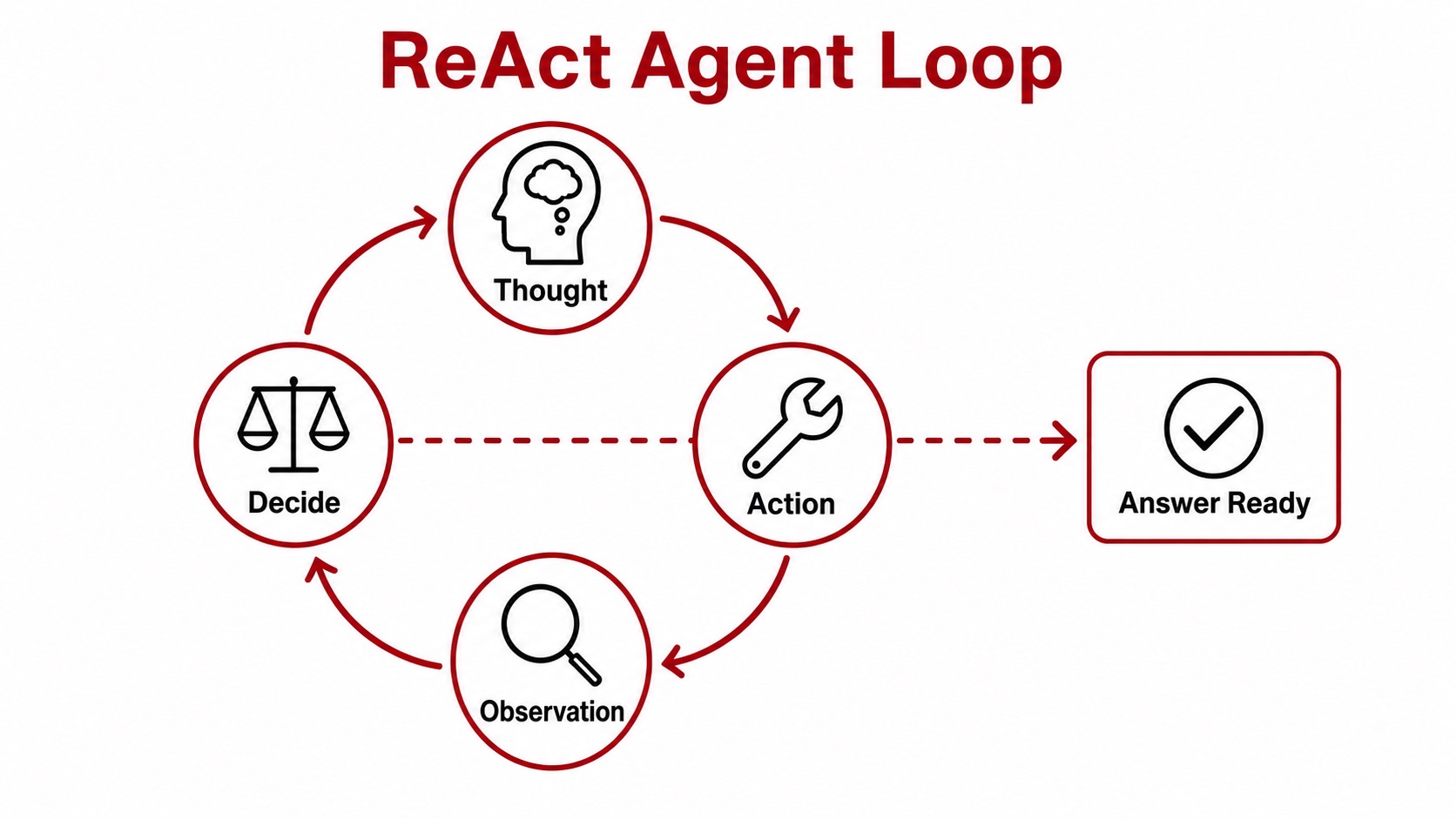
In an agentic system, your code says: while goal_is_not_met: ask_llm_what_to_do_next().
This shift allows agents to handle incredibly complex, multi-step, and ambiguous requests that would be impossible to hardcode. However, it also introduces unpredictability. The agent might get stuck in an infinite loop, use the wrong tool, or hallucinate a conclusion.
To make agents reliable, we need a structured framework for how they "think." The most famous of these frameworks is ReAct.